
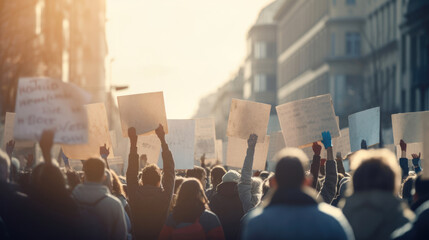
Protests are an important part of a democratic society. They allow citizens to express disagreement, raise public concerns, demand accountability and draw attention to issues that matter.
The Constitution of India protects the right of citizens to assemble peacefully and without arms under Article 19(1)(b). However, this right is not absolute. Reasonable restrictions can be imposed in the interests of public order, among other grounds.
This raises an important question:
When does a peaceful protest cross the line and become a criminal offence?
The answer depends on what happens during the protest, the common object of the gathering, whether lawful orders are violated, and whether protesters engage in violence, obstruction or other unlawful acts.
Let’s understand when a protest can result in criminal liability
- Not every protest is a crime
Participating in a peaceful protest does not automatically make a person a criminal.
Citizens generally have the right to express their views and assemble peacefully, subject to lawful restrictions.
For example, peacefully holding placards, raising slogans, conducting a march in accordance with applicable rules, or sitting in a peaceful demonstration may fall within the protection of constitutional freedoms.
However, the situation can change when a protest involves violence, destruction of property, criminal force, intimidation, or other unlawful conduct.
The key distinction is between peaceful exercise of a constitutional right and conduct that amounts to an offence.
- What does the law say about an unlawful assembly?
Under Section 189 of the Bharatiya Nyaya Sanhita, 2023 (BNS), an assembly of five or more persons may be considered an unlawful assembly when its common object falls within specified unlawful purposes.
These include, among other things:
- Using criminal force or the threat of criminal force against the Government or a public servant
- Resisting the execution of law or legal process
- Committing mischief, criminal trespass or another offence
- Using criminal force to obtain possession of property or enforce a right
- Using criminal force to compel a person to do something they are not legally bound to do, or to stop them from exercising a lawful right.
Importantly, an assembly that was lawful when it began can subsequently become unlawful.
Therefore, simply being part of a large gathering does not by itself make someone criminally liable. The nature and common object of the assembly matter.
- Continuing in an unlawful assembly can create liability
Section 189 of the BNS also provides criminal liability for a person who, knowing the facts that make an assembly unlawful, intentionally joins or continues in it.
The section provides for imprisonment of up to six months, or fine, or both in such circumstances.
If the assembly has been lawfully commanded to disperse and a person knowingly continues to participate, the consequences can be more serious, with imprisonment that may extend to two years, or fine, or both.
This means that protesters should pay attention to lawful directions issued during a demonstration.
- What happens when a protest turns violent?
A peaceful protest and a violent protest are legally very different.
Under Section 191 of the BNS, when force or violence is used by an unlawful assembly, or by a member of it in prosecution of the assembly’s common object, the offence of rioting may arise.
Rioting can be punishable with imprisonment of up to two years, or fine, or both.
If the person is armed with a deadly weapon or an object likely to cause death when used as a weapon, the punishment may extend to five years, or fine, or both. Therefore, once a demonstration involves violence, the legal consequences can become substantially more serious.
- Can one protester be held responsible for another person’s actions?
Under Section 190 of the BNS, where an offence is committed by a member of an unlawful assembly in prosecution of the assembly’s common object, or where the members knew that the offence was likely to be committed in pursuit of that object, every person who was a member of that assembly at the relevant time may be guilty of that offence.
This does not mean that every person present at every protest automatically becomes responsible for everything that happens.
The facts matter, including:
- Whether the assembly was unlawful
- What its common object was
- What the members knew
- What offence was committed
- Whether the offence was connected with the common object or was known to be likely to occur.
This is why simply saying, “I was only there as a protester,” may not always be enough to determine criminal liability.
- Disobeying a lawful order can also have consequences
Protests can also be affected by lawful orders issued by competent public authorities.
For example, Section 163 of the Bharatiya Nagarik Suraksha Sanhita, 2023 (BNSS) empowers certain Executive Magistrates to issue orders in urgent cases involving, among other things, danger to human life, health or safety, disturbance of public tranquillity, riot or affray. Such an order can direct individuals or the public generally to abstain from a particular act or take certain steps.
Separately, Section 223 of the BNS deals with disobedience to an order duly promulgated by a public servant. Depending on the consequences of the disobedience, the section provides for imprisonment of up to six months or one year, along with possible fines.
Therefore, protesters should understand what order has been issued, who issued it, whether it is legally applicable, and what conduct it actually prohibits.
- Blocking roads or public spaces can create legal issues
A protest may take place in a public area, but this does not mean that protesters have an unrestricted right to occupy every public road or prevent others from using it.
Depending on the location and circumstances, obstruction, unlawful assembly, disobedience of a lawful order, or other offences may become relevant.
There may also be state-specific laws regulating assemblies and processions. For example, Kerala has the Kerala Public Ways (Restriction of Assemblies and Processions) Act, 2011, which provides for restrictions and regulation concerning assemblies and processions on public ways.
The applicable law can therefore depend on where the protest takes place and what exactly the protesters are doing.
- Peaceful protest does not mean unlimited freedom
The right to protest is an important democratic right, but it exists alongside other rights and public interests.
A protest should not become an excuse for:
- Violence or assault
- Destruction of public or private property
- Criminal intimidation
- Obstruction of lawful public functions
- Attacking or obstructing police or other public servants
- Resisting lawful legal processes
- Ignoring applicable lawful restrictions or orders.
The BNS separately addresses offences such as assaulting or obstructing a public servant while suppressing a riot, promoting enmity between groups, and other conduct that may become relevant depending on the facts.
Before participating in a protest
If you are planning to participate in a protest, consider the following:
- Know the rules applicable to the location.
- Understand whether any permission, route restriction or other lawful condition applies.
- Remain peaceful and avoid violence or property damage.
- Do not carry weapons or objects intended to be used as weapons.
- Pay attention to lawful directions from competent authorities.
- Do not assume that being part of a crowd removes individual criminal responsibility.
- If police initiate criminal proceedings, seek legal advice promptly rather than relying on assumptions about your rights.
How RJ Legal Associates helps
At RJ Legal Associates, we help individuals understand their legal rights and responsibilities in matters involving protests, demonstrations and criminal proceedings.
We assist with:
- Legal advice concerning participation in protests and demonstrations
- Understanding criminal liability under the Bharatiya Nyaya Sanhita, 2023
- Advice concerning unlawful assembly and rioting allegations
- Legal guidance relating to orders issued by public authorities
- Assistance in cases involving arrest, FIRs and criminal proceedings
- Representation and legal strategy in protest-related criminal matters
- Advice concerning constitutional rights and lawful restrictions on assemblies.
A protest is an important way for citizens to make their voices heard. But exercising that right also requires awareness of the legal boundaries surrounding public assemblies.
The important question is not simply “Was there a protest?”
The real questions are:
- Was the assembly peaceful?
- What was its common object?
- Were any lawful orders in force?
- Did anyone use force or commit another offence?
- What did each participant know and do?
Understanding these distinctions can help protesters exercise their constitutional rights responsibly while reducing the risk of unintended criminal liability.
